
How Much Does a Church Sound System Cost in 2026 and 2027?
How Much Does a Church Sound System Cost in 2026?
If your church is considering a new sound system, one of the first questions is probably:
How much is this actually going to cost?
The answer can vary significantly.
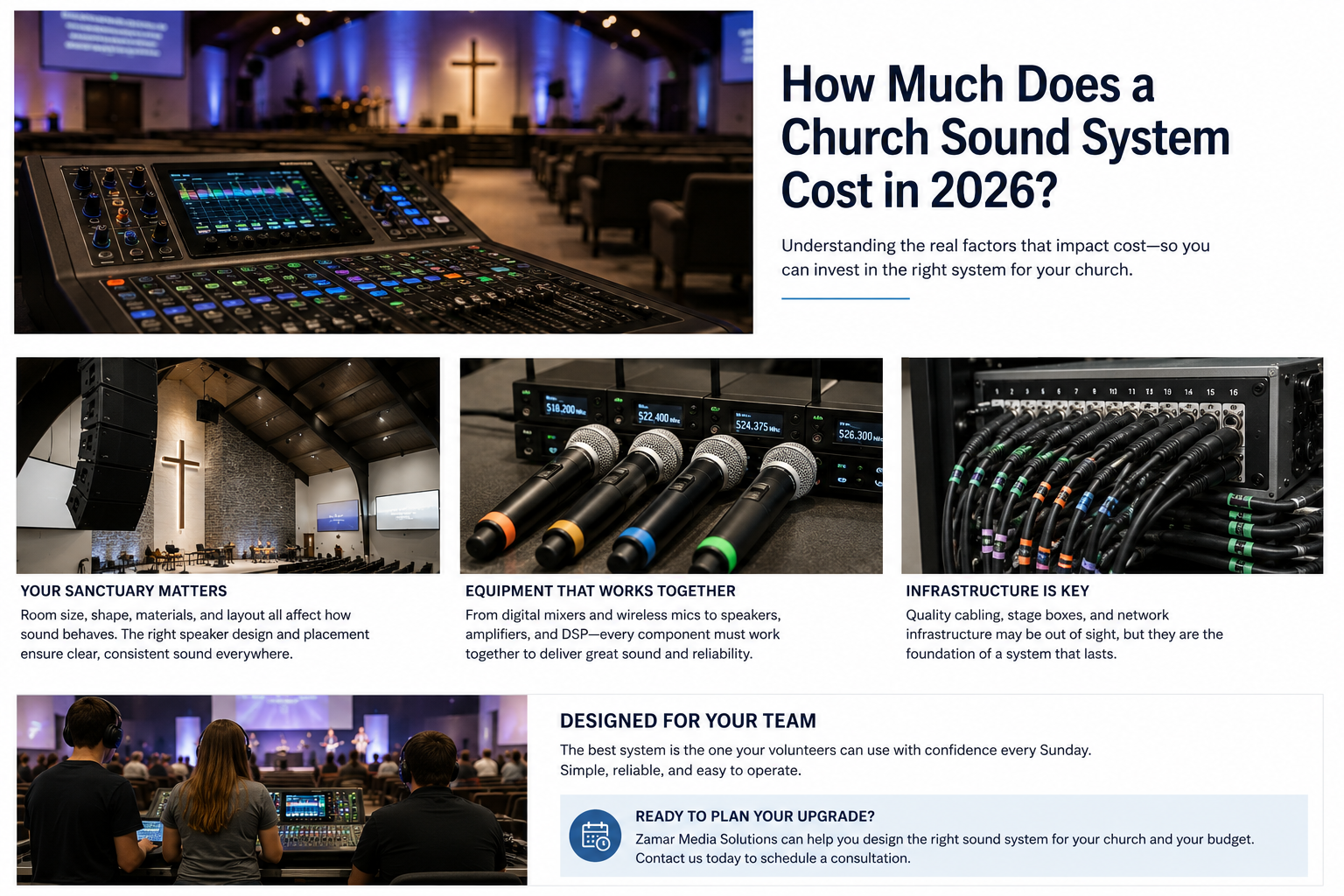
A smaller church may be able to build a quality system for tens of thousands of dollars, while a large worship center with multiple speaker zones, wireless microphones, digital mixing, stage infrastructure, and advanced processing can require a much larger investment.
The important thing isn't simply spending more money. It's designing the right system for your room, worship style, congregation, volunteers, and long-term needs.
At Zamar Media Solutions, we've been designing and installing professional AV systems for churches and houses of worship for decades. Here's what churches should know when planning a sound system budget in 2026.
What Does a Church Sound System Typically Cost?
As a general planning range, churches might expect complete professionally installed sound systems to fall somewhere around:
Small churches and chapels: $10,000–$25,000
These systems may include a basic digital mixer, main loudspeakers, several microphones, necessary amplification or processing, cabling, installation, and system configuration.
Mid-size churches: $25,000–$75,000
At this level, systems often include more advanced loudspeaker coverage, digital mixing consoles, wireless microphones, stage boxes, personal monitoring, DSP, additional inputs and outputs, and more extensive infrastructure.
Large churches and worship centers: $75,000–$200,000+
Larger facilities can require line-array or distributed loudspeaker systems, subwoofers, multiple speaker zones, extensive wireless systems, digital networking, advanced DSP, monitor systems, redundant infrastructure, and integration with broadcast or livestreaming systems.
These numbers are planning ranges, not quotes. Every sanctuary is different, and two churches with the same seating capacity can require very different systems.
That's why a professional system design should come before the equipment list.
What Determines the Cost of a Church Sound System?
There are several major factors that determine how much a church audio system will cost.
1. The Room
The sanctuary itself is one of the most important parts of the sound system.
Ceiling height, room width, seating layout, balconies, architectural materials, stage location, and acoustic characteristics all affect how sound behaves.
A 300-seat traditional sanctuary with high ceilings and reflective surfaces may require a very different solution than a 300-seat modern worship space with acoustic treatment.
This is why selecting speakers based only on room capacity can be a costly mistake.
The goal is not simply to make the room loud.
The goal is to achieve clear, consistent sound throughout the congregation.
2. The Loudspeaker System
The loudspeaker system is often one of the largest portions of a church audio budget.
Depending on the facility, this might include:
Main loudspeakers
Subwoofers
Front fills
Delay speakers
Balcony fills
Stage monitors
Amplification
Digital signal processing
The right loudspeaker system should provide consistent coverage so the person sitting in the front row and the person sitting in the back of the sanctuary both have a good listening experience.
Buying larger or more expensive speakers doesn't automatically solve coverage problems.
Proper speaker selection, placement, aiming, processing, and tuning are just as important as the equipment itself.
3. The Mixing Console
Modern digital mixing consoles give churches capabilities that would have required significantly more equipment years ago.
A church may need to mix:
Pastoral microphones
Worship vocals
Drums
Guitars
Keyboards
Choirs
Playback devices
Video content
Livestream audio
Stage monitors
In-ear monitors
The number of inputs, outputs, monitor mixes, volunteers, and broadcast requirements all help determine which console is appropriate.
One of the most common mistakes is purchasing a console that meets today's requirements without considering what the ministry may need several years from now.
4. Wireless Microphones
Wireless systems can become a significant portion of a church AV budget.
A church may need wireless microphones for pastors, worship leaders, vocalists, guest speakers, drama productions, or special events.
Professional wireless systems also require proper frequency coordination and antenna system design.
This is particularly important when many wireless microphones and in-ear monitor systems are operating simultaneously.
Simply adding wireless systems one at a time without considering the overall RF environment can eventually create interference and reliability problems.
5. Stage Infrastructure and Cabling
Some of the most important parts of an AV system are the parts the congregation never sees.
A professional installation may include:
Microphone and signal cabling
Network cabling
Stage boxes
Equipment racks
Patch panels
Power distribution
Digital audio networking
Conduit
Wall plates and floor boxes
Equipment mounting
Good infrastructure makes a system easier to maintain, troubleshoot, expand, and upgrade.
It's also one of the areas where planning ahead can save a church considerable money later.
6. Installation, Programming, and System Tuning
Professional AV installation involves much more than mounting speakers and connecting cables.
After installation, the system needs to be configured and tuned for the room.
This may involve speaker alignment, equalization, gain structure, delay configuration, DSP programming, wireless coordination, console programming, testing, and troubleshooting.
A professionally tuned system can often sound dramatically better than the same equipment installed without proper configuration.
That's one reason comparing AV proposals based only on equipment prices can be misleading.
7. Acoustics
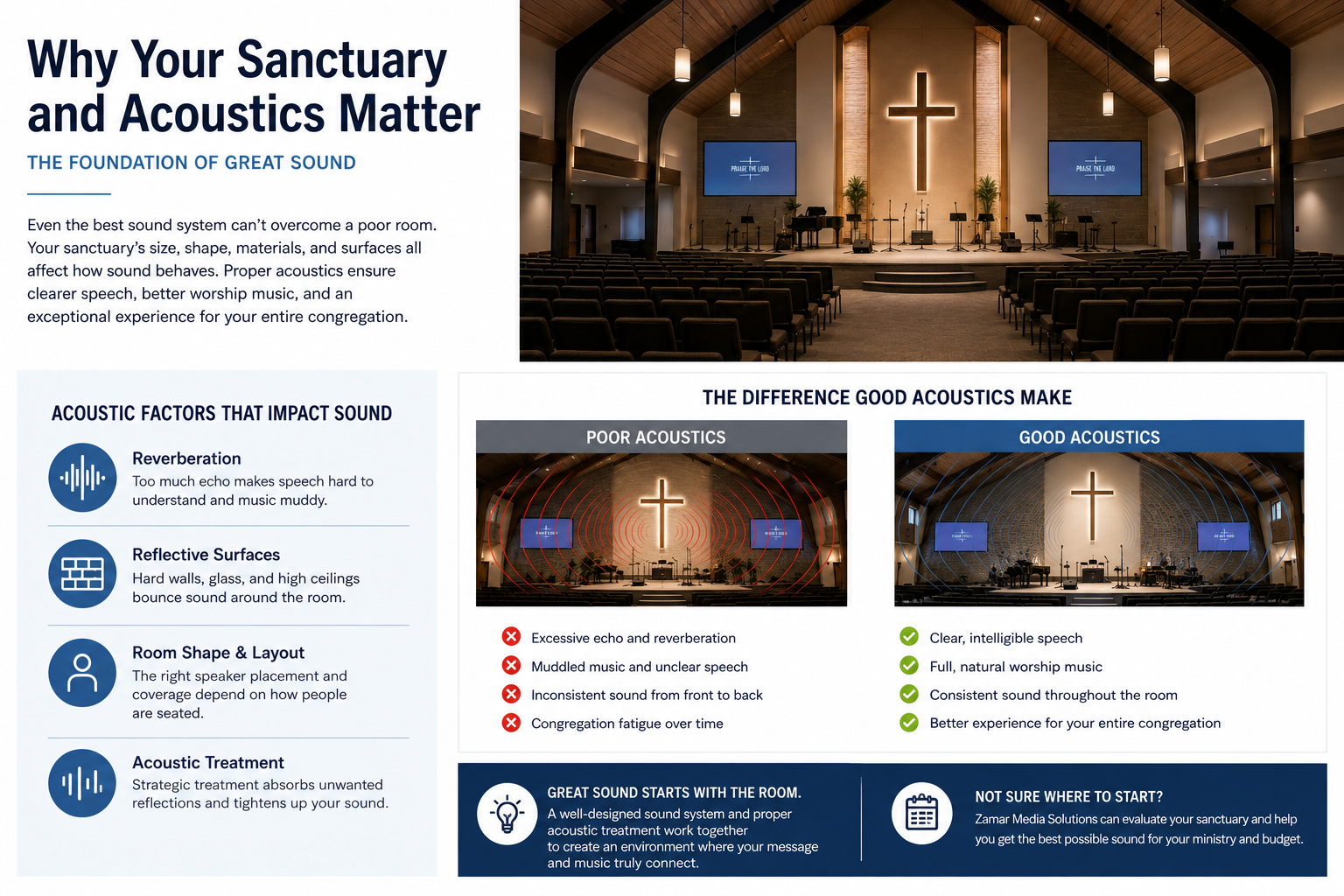
Sometimes the biggest sound problem isn't the sound system.
It's the room.
Hard walls, glass, concrete, high ceilings, and other reflective surfaces can create excessive reverberation that makes speech difficult to understand and music sound muddy.
Installing more powerful speakers doesn't necessarily solve those problems.
In some facilities, investing part of the budget in acoustic treatment can produce a greater improvement than spending that same money on more expensive audio equipment.
A good AV design considers the sound system and the acoustics together.
Can We Reuse Our Existing Church AV Equipment?
Often, yes.
A church AV upgrade doesn't always mean replacing everything.
Existing equipment may still have years of useful life remaining.
For example, a church might keep its existing digital console while replacing an outdated loudspeaker system. Another church might keep its speakers but upgrade its wireless microphones, DSP, cabling, or stage infrastructure.
Before designing a new system, it's worth evaluating what equipment can reasonably remain.
At Zamar Media, we believe your budget should go toward the areas that will make the greatest difference—not replacing equipment simply because something newer exists.
Can a Church Sound System Be Upgraded in Phases?
Absolutely.
For many churches, a phased upgrade is the most practical approach.
Instead of completing a large project all at once, a church might create a long-term AV plan and divide the project into stages.
For example:
Phase 1: Infrastructure and cabling
Phase 2: Mixing console and stage equipment
Phase 3: Loudspeaker system
Phase 4: Wireless microphones and monitoring
Phase 5: Livestream, video, or lighting improvements
The important part is designing the overall system first.
Otherwise, churches can end up purchasing equipment during Phase 1 that doesn't integrate properly with equipment purchased during Phase 3.
A good phased plan allows each investment to become part of the final system.
How Long Should a Church Sound System Last?
A properly designed professional sound system can serve a church for many years.
Different components have different lifespans.
Speakers, infrastructure, racks, and cabling may remain useful for a very long time, while digital consoles, wireless systems, computers, and network-based equipment may have shorter technology cycles.
Rather than thinking of an AV system as something that must be completely replaced every few years, churches should think about creating a strong infrastructure that can evolve over time.
That approach can significantly reduce the total cost of ownership.
Should Our Church Buy the Equipment Ourselves?
It's tempting to search online for individual equipment prices and purchase everything separately.
But professional AV systems are systems—not collections of individual products.
Speakers need to work with the room.
Amplifiers need to work with the speakers.
The console needs enough inputs and outputs.
Digital networking needs to be properly configured.
Wireless equipment needs to operate together.
The livestream system needs the correct audio feeds.
And everything needs to be usable by the people actually operating it every Sunday.
A lower equipment price doesn't necessarily mean a lower project cost if equipment later needs to be replaced, reconfigured, or redesigned.
Don't Forget About Your Volunteers
This is especially important for churches.
Your sound system shouldn't require a professional touring engineer to operate Sunday morning worship.
Many church AV systems are run primarily by volunteers, so usability should be part of the system design from the beginning.
That might mean creating console scenes, simplifying controls, labeling equipment, establishing startup and shutdown procedures, or providing training for the church's technical team.
The best church AV system isn't necessarily the one with the most features.
It's the system your team can confidently operate every week.
How Should Your Church Set an AV Budget?
Instead of starting with a list of equipment, start with the problems you're trying to solve.
Ask questions such as:
Can everyone clearly understand the pastor?
Is worship music consistent throughout the sanctuary?
Are volunteers struggling with the current equipment?
Are wireless microphones unreliable?
Is the system difficult to maintain?
Does your livestream sound significantly worse than the room?
Are you planning to expand your worship or production capabilities?
Once those goals are clear, an AV integrator can help determine where your budget will have the greatest impact.
Planning a Church Sound System Upgrade?
If your church is considering a new sound system, replacing aging equipment, or simply trying to understand what an upgrade might cost, Zamar Media Solutions can help.
We've been serving churches and houses of worship throughout the San Francisco Bay Area and beyond for decades. Our team can evaluate your existing system, identify what's working and what isn't, and help develop a solution that fits your ministry, facility, volunteers, and budget.
Whether you're planning a complete sanctuary renovation or trying to determine the smartest next upgrade, we'll help you understand your options before you invest.
Ready to talk about your church's sound system?
Contact Zamar Media Solutions today to schedule a consultation and start planning an AV system designed specifically for your church.